The Executive Travel Health Checklist
A delayed flight can mean a missed medication dose. A packed schedule can leave little time for sleep. An illness abroad can turn into a search for care in an unfamiliar system.
This travel health checklist helps executives and frequent business travelers prepare medications, records, and care contacts before departure, maintain basic routines during the trip, and follow up when they return. Use the sections that fit your destination, itinerary, and medical needs.
Before Departure: Review Your Health and Destination
Most healthy adults do not need a medical appointment before every routine trip. International travel, recent illness or surgery, pregnancy, and complex medical conditions may require more preparation.
Arrange Travel Advice When Needed
- Review new symptoms or recent changes in your health with your clinician before traveling.
- For international trips, arrange destination-specific advice about four to six weeks ahead when possible. If departure is sooner, still ask what can be done.
- Check current destination guidance for vaccines, preventive medicines, and relevant health risks.
- Share your itinerary, trip length, planned activities, and any remote locations with the clinician advising you.
- Ask whether a recent procedure, illness, or ongoing condition changes your travel plans.
Use CDC Travelers’ Health for destination information. CDC recommends preparing in advance so there is time to address travel-related vaccination and medication needs. Read the guidance on traveling abroad with medicine.
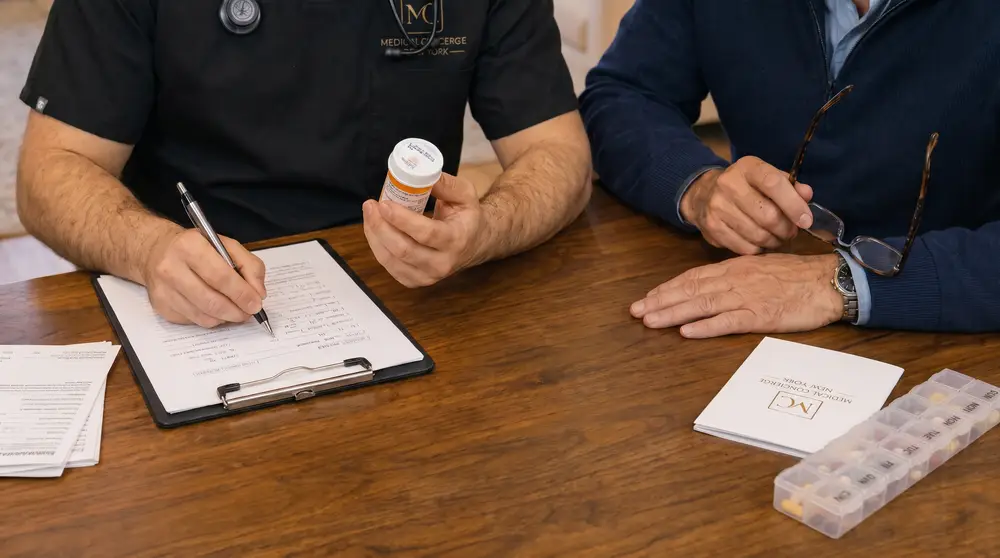
Pack and Plan Your Medications
Check supplies before departure, especially if a refill, authorization, or special storage arrangement takes time.
Medication Packing Checklist
- Bring enough for the trip and an appropriate allowance for delays, within applicable travel restrictions.
- Keep essential medicines in carry-on luggage.
- Use original labeled containers for international travel and carry prescription documentation when needed.
- Check medication rules for your destination and transit countries, including any permit or quantity limits.
- Confirm temperature and refrigeration requirements with your pharmacist.
- Carry an accurate list of medicine names, doses, routes, and schedules.
Plan Dosing Across Time Zones
- Ask your clinician or pharmacist how to handle time-sensitive medicines when crossing time zones.
- Write down the agreed schedule and what to do if a dose is missed.
- Make sure reminders reflect that plan rather than simply switching to the new local time.
Medication rules vary between countries. Do not assume a prescription legal at home can be brought abroad without restrictions. Do not improvise dose changes to fit flights or meetings. Review the CDC guidance on traveling abroad with medicine.
Keep Essential Information and Care Contacts Accessible
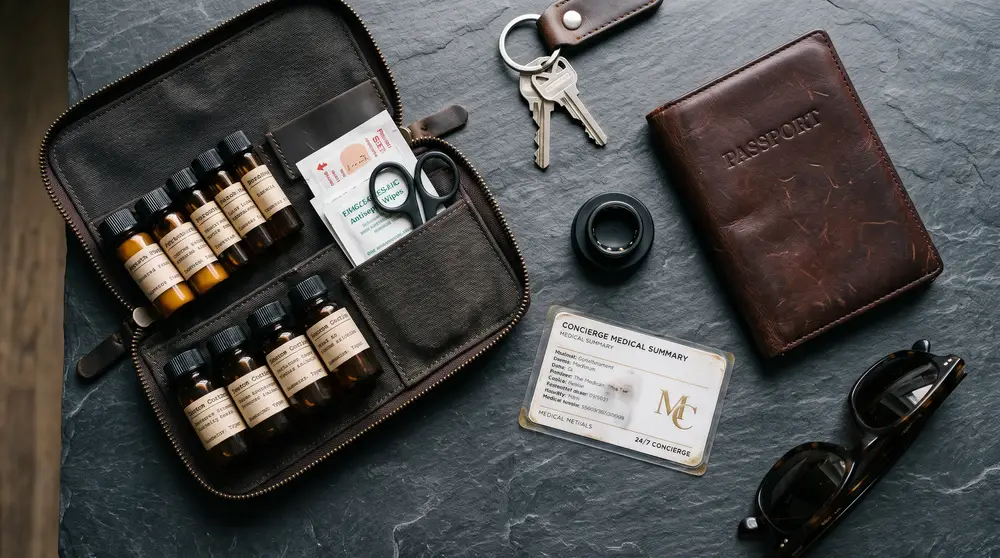
Maintain a brief health summary in a secure place you can access while away. Include only what is useful for care, and keep a backup in case your phone is unavailable.
- Current medications and allergies, including the reactions.
- Significant conditions, procedures, and relevant devices or implants.
- Usual clinician’s contact details and after-hours instructions.
- Emergency contact information.
- Insurance or travel-assistance information.
Confirm How You Will Obtain Care
- Save the local emergency number and identify nearby medical services.
- Check whether insurance covers care at the destination, including exclusions and payment arrangements.
- Review emergency evacuation coverage when relevant; do not assume it is included.
- Confirm what your usual care team can provide while you are away.
Telehealth depends on clinical suitability and the clinician’s authorization to practice where you are located. A membership does not guarantee treatment from every state or country. Read the HHS guidance on licensing across state lines.
Travel Contact Sheet
Complete this in your private copy.
| Detail | Information |
|---|---|
| Destination and travel dates | ________________ |
| Usual clinician and phone | ________________ |
| After-hours instructions | ________________ |
| Emergency contact and phone | ________________ |
| Local emergency number | ________________ |
| Nearby medical facility | ________________ |
| Insurer or travel-assistance phone | ________________ |
| Location of medication and allergy summary | ________________ |
During Travel: Protect Basic Health Routines
Leave Room for Sleep
- Protect a realistic sleep window instead of filling every available hour.
- Allow recovery time after a major time-zone change when the itinerary permits.
- Limit caffeine close to your intended bedtime.
- Avoid using alcohol to help you sleep.
- If jet lag repeatedly disrupts your trips, ask your clinician about an individualized plan rather than trying a new sleep medicine on the flight.
Keep Meals and Fluids Manageable
- Plan time to eat and carry suitable snacks when meals may be delayed.
- Drink fluids regularly, with attention to heat and activity.
- Follow any fluid or dietary restrictions from your treating clinician.
- Keep alcohol intake modest and avoid letting business dinners replace sleep.
You do not need a perfect routine. Aim for habits that are practical enough to repeat during an ordinary travel day.
Move During Long Journeys
- Move your ankles and calf muscles while seated.
- Get up and walk periodically when it is safe, or take breaks during long drives.
- Before travel, discuss additional precautions if you have a history of blood clots, recent surgery, active cancer, pregnancy, or other significant risks.
Compression stockings or preventive medication may be appropriate for some higher-risk travelers. Do not start aspirin or a blood thinner solely for travel without individualized medical advice. See the CDC guidance on blood clots during travel.
Take Destination-Specific Precautions
- Follow local food and water precautions where relevant.
- Use insect protection appropriate to the destination.
- Wash hands regularly and use hand sanitizer when soap and water are unavailable.
- Use sun protection, seat belts, and safe transportation.
CDC’s travel guidance covers these precautions and recommends checking medical coverage before international travel. Review the CDC guide to safe and healthy travel.
If You Become Ill or Injured While Away
Seek the Appropriate Level of Care
For a routine concern, contact an available licensed clinician or local service. Your usual team may be able to help with records and coordination, but an examination or treatment may need to happen locally.
For chest pain, severe difficulty breathing, signs of stroke, a severe allergic reaction, major injury, or another potentially life-threatening emergency, contact local emergency services immediately. Do not wait for a concierge or telehealth response.
New one-sided leg swelling or pain after prolonged travel also needs prompt assessment. If accompanied by breathing difficulty or chest pain, seek emergency care. Read the CDC guidance on blood clots during travel.
Keep a Record of Care Received
- Obtain the visit summary or discharge instructions.
- Keep relevant test results and imaging reports.
- Record new medicines by name, dose, and instructions, including the generic name when available.
- Clarify which existing medicines were changed or stopped.
- Note pending results, follow-up timing, and whom to contact.
- Inform your usual team about significant medical events.
After You Return: Complete the Follow-Up
- Share relevant outside records with your usual care team.
- Ask the appropriate clinician or pharmacist to clarify medication changes.
- Arrange recommended tests or consultations.
- Confirm who will review any outstanding results.
- Seek advice for persistent, new, or worsening symptoms.
If you feel unwell after travel, particularly with fever, tell the clinician where you went and when. Include relevant activities, exposures, and treatment received. Do not dismiss symptoms as jet lag without considering the travel history. See the CDC after-travel guidance.
Follow-Up Tracker
| Issue or recommendation | Next step | Responsible clinician or office | Due date |
|---|---|---|---|
| ________________ | ________________ | ________________ | ________________ |
| ________________ | ________________ | ________________ | ________________ |
| ________________ | ________________ | ________________ | ________________ |
Last Check Before Leaving
- Medicines are accessible, correctly packed, and permitted at the destination.
- Dosing and storage questions have been answered.
- Essential records and care contacts are available.
- Destination health needs and medical coverage have been reviewed.
- I know how to obtain local care, including emergency help.
Travel Healthcare Coordination With MCNY
Medical Concierge NY (MCNY) provides healthcare access and navigation services for executives, professionals, and families. Depending on membership arrangements, location, and available services, support may include help organizing records, connecting with an appropriate clinical team, and arranging follow-up after care received away from home.
Clinical evaluation and treatment are provided by licensed professionals through affiliated professional medical practices. Discuss your itinerary and expected support before departure so the available services and limitations are clear.
Visit Medical Concierge NY to discuss membership and healthcare coordination.
This checklist is for general education and is not individualized medical or travel-health advice. Recommendations depend on destination, itinerary, medical history, medications, pregnancy status, and other personal factors. Consult an appropriately licensed healthcare professional about your needs. Seek local emergency care for potentially life-threatening symptoms. MCNY provides concierge and healthcare-navigation services. Clinical services are independently provided through affiliated professional medical practices and may be billed separately. Membership does not replace health or travel insurance.

Adam Tilson, PA-C
February 11, 2026
Download resource
Medicine built around you, not schedules. A personal physician who knows your history, your goals, and what matters most to your health.